But

The One Store-Bought Coffee That Every Barista Swears By

The One Store-Bought Coffee That Every Barista Swears By

If you’ve ever stood in a coffee aisle wondering which bag to choose, you’re not alone. The options are endless, but the right beans can transform a mundane morning ritual into something extraordinary. Here’s the truth: the best store-bought coffee isn’t about flashy branding or vague promises—it’s about precision, care, and a few overlooked details that separate the ordinary from the exceptional. Coffee pros don’t just guess when they buy beans. They hunt for specifics. First up: roast dates. “A bag without a roast date is a red flag,” says Riley Westbrook, a specialty roaster. “Look for beans roasted within…
Read More
Espresso and High-End Audio: A Parallel Obsession

Espresso and High-End Audio: A Parallel Obsession

This is worth savoring: Two years ago, I was a Keurig-dependent caffeine addict. Today, I’m staring at a Legato V2 espresso machine, convinced it’s the missing piece to a life of refined taste. But here’s the twist—this journey mirrors another obsession: high-end audio. Both are about chasing perfection, and both are riddled with shiny gadgets promising miracles. The shift began with a French press. I bought one on a whim, filled it with pre-ground beans, and waited 10 minutes for “more coffeeness.” It was better than instant, but only after adding chocolate and milk. For two years, I clung to…
Read More
Stingless Bees Could Revolutionize Coffee Farming in Brazil

Stingless Bees Could Revolutionize Coffee Farming in Brazil

There’s something brewing in Brazil’s coffee fields—and it’s not just the beans. A new study reveals that native stingless bees might be the key to boosting yields without sacrificing pest control. Researchers found that coffee branches near colonies of Scaptotrigona depilis produced 67% more fruit than those farther away, hinting at a symbiotic relationship between bees and arabica plants. This isn’t just a lab experiment—it’s a real-world test on full-sun farms, where bees coexist with pesticides and conventional farming practices. The study, published in Frontiers in Bee Science, tracked six conventional farms in Minas Gerais and São Paulo, placing 10…
Read More
The Paradox of Success: Why Specialty Coffee’s Moral Narrative Falters

The Paradox of Success: Why Specialty Coffee’s Moral Narrative Falters

Real talk: The specialty coffee industry’s moral narrative is built on a fragile premise—producers are poor, vulnerable, and in need of rescue. But when they succeed, the system often resists. This isn’t just about economics; it’s about identity. Specialty coffee sells itself as a force for good, yet its success metrics quietly contradict that mission. The industry’s language frames producers as struggling, dependent actors, while roasters and consumers are cast as saviors. But when a farmer like Felipe Sardi of La Palma & El Tucán thrives, paying neighbors three times the regional price and reinvesting in community, the narrative shifts.…
Read More
How to Master Light Roast Development Without Sacrificing Flavor

How to Master Light Roast Development Without Sacrificing Flavor

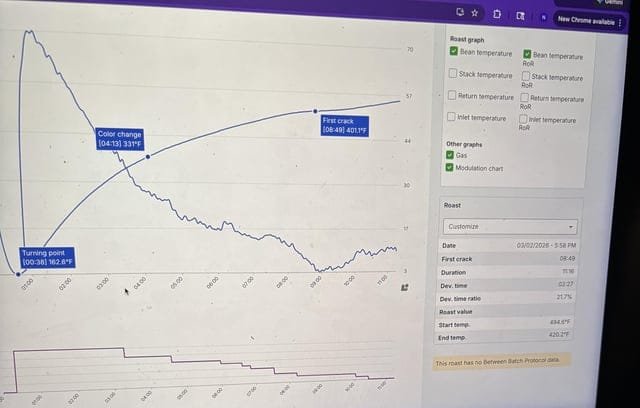
This is worth savoring: Light roasts demand precision, and the devil is in the details of timing. If you’re chasing a filter roast with a short dry phase and Maillard, you’re already in a tightrope act—balancing speed and depth. The numbers you’re working with—4:15 dry, 3:15 Maillard, 1:25 development—hint at a race against time. But here’s the catch: your ROR (rate of rise) spikes during development, threatening to cut the window for complexity. The question isn’t just about how to slow the roast—it’s about how to let the beans breathe without losing their brightness. The core issue lies in the…
Read More
Is Paying $2,000 for a Roasting Course Worth It?

Is Paying $2,000 for a Roasting Course Worth It?

There’s something brewing in your kitchen—or your local coffee shop—that could redefine your craft. A 40-hour roasting and cupping course costs $2,000, taught by someone who’s mastered the science and art of coffee for 15 years. The instructor’s credentials? SCA Authorized Trainer, Q Grader, and judge for Barista and Latte Art championships. That’s not just a résumé; it’s a guarantee of expertise. But here’s the question: Is this investment worth it, or can you learn everything you need through YouTube tutorials and books? The course promises more than just theory. It dives into roasting fundamentals: turning points, drying phases, first…
Read More
The Roast That Smelled Like Heaven

The Roast That Smelled Like Heaven

This is worth savoring: A rookie roaster’s obsession with unlocking sweet chocolate notes in a Costa Rican blend led to a revelation that’s equal parts science and serendipity. After three days of trial, error, and a dash of madness, the beans finally exhaled the aroma of hot cocoa—so potent even a coffee-hating spouse declared it divine. The journey? A masterclass in how temperature, timing, and patience can transform a batch of coffee into a sensory masterpiece. The first roast, a dark, slow burn at 23 on the Cubean, yielded underwhelming espresso. The beans, charged at 180°C and roasted to 209°C…
Read More
Mastering Light Roasts on the Huky 500: A Roaster’s Dilemma

Mastering Light Roasts on the Huky 500: A Roaster’s Dilemma

The Huky 500 is a beast of a roaster—until you try to coax it into a light roast. For those chasing the delicate, floral notes of Ethiopian naturals or the bright acidity of Rawandans, the machine’s strength lies in its medium roast comfort zone. But dialing back to light? That’s where the real work begins. The challenge? Balancing first crack timing, development window, and heat management without letting the beans bake before they even crack. The core issue hinges on temperature control. Most users report first crack erupting around 410–422°F, which is already in the medium roast territory. To hit…
Read More
GS3 vs. GS4: Should You Invest in La Marzocco’s Iconic Machine or Wait for the Next Big Thing?

GS3 vs. GS4: Should You Invest in La Marzocco’s Iconic Machine or Wait for the Next Big Thing?

Get ready to sip on this: The La Marzocco GS3 is a beast, but is it worth the $8000 price tag—or should you wait for the next big thing? If you’re eyeing an upgrade from a Profitec Pro 700, you’re likely chasing steam power, temperature stability, and volumetrics. The GS3 delivers all of that, but its 2008 design feels like a relic in a world of rapid innovation. The Linea Mini’s recent “R” update and the Strada X1’s $20k price tag have left many wondering: Is the GS3 a relic, or still the gold standard? The GS3’s appeal lies in…
Read More
Does the Steam Wand Angle Matter for Microfoam? Here’s the Truth

Does the Steam Wand Angle Matter for Microfoam? Here’s the Truth

Listen up: The steam wand angle is a hot topic in barista circles, and for good reason. Whether you’re chasing velvety microfoam or perfect latte art, the angle at which you position the wand can make or break your results. But here’s the catch—most baristas debate it like it’s the final round of a championship, when the real answer is simpler. You’ve probably seen videos showing every angle from 45 degrees to straight down, each claiming to be the holy grail. Yet, the science behind it? Less clear. The truth is, the steam wand angle isn’t a one-size-fits-all solution. It’s…
Read More