⏱ 1 min read
The Short Version
Forget Robusta dominance; South India Coffee Company is using genomic research and interspecies hybrids to engineer a climate-resilient future. By partnering with Kew Gardens, they’re turning estates into living laboratories to ensure specialty coffee survives an increasingly volatile environment.
In This Article
Pour yourself a cup for this one: the narrative of Indian coffee is shifting from historical footnotes to cutting-edge innovation. While the region has long been dominated by Robusta production, a new generation of producers is reclaiming the spotlight through rigorous scientific research. At the forefront is South India Coffee Company (SICC), led by Akshay Dashrath and Komal Sable, who are moving beyond traditional farming to address the existential threats facing the industry.
The hope isn’t to have Excelsa or these hybrids replace Arabica or Robusta.
Beyond Traditional Cultivation
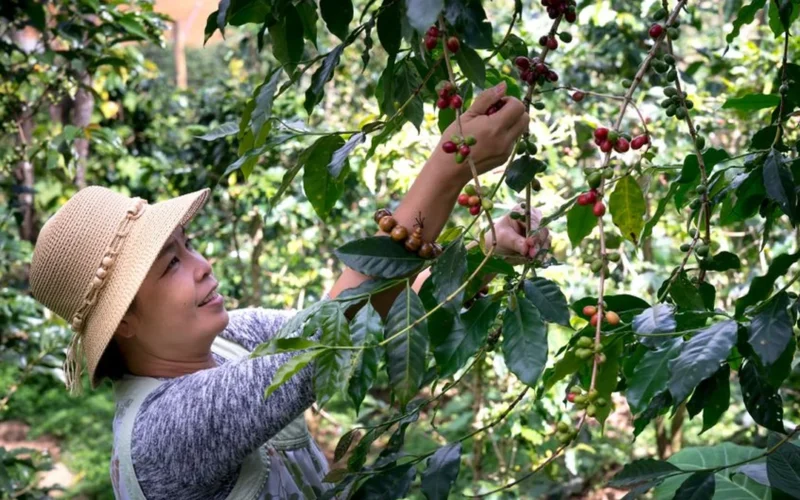
Based at the Mooleh Manay Estate in Karnataka, SICC isn’t just growing beans; they are conducting high-level genomic and agronomic studies. The estate utilizes a diverse native shade canopy—including ficus and Indian beech trees—to create a complex ecosystem that supports not only coffee but also pepper, vanilla, and fruit. This multi-crop approach provides natural nutrient cycling and income stability, but it is their focus on genetic diversity that truly sets them apart. By partnering with the Royal Botanic Gardens, Kew, the team has moved past “boundary-tree folklore” to scientifically confirm species like Excelsa and develop interspecies hybrids. The hope isn’t to have Excelsa or these hybrids replace Arabica or Robusta. Instead, they aim to provide growers with climate-resilient options as traditional varieties face increasing pressure.
Engineering Climate Resilience
As climate change threatens wild Arabica populations, SICC is pivoting toward low-intervention, heat-tolerant species. Their Living Germplasm Garden serves as a laboratory for testing how different species and hybrids, such as Libex (Excelsa × Liberica), handle extreme environmental shifts. During recent trials, they closely monitored soil moisture and vapor pressure to understand how plants recover from severe heat stress. This data-driven approach allows them to identify which varieties can thrive in warmer, lower-elevation zones where Arabica struggles. By integrating modern processing techniques with deep botanical research, SICC is ensuring that the future of Indian coffee is both sustainable and technologically advanced. Do you think exploring non-traditional species like Excelsa is the key to saving specialty coffee from climate change?
Questions & Answers
How is South India Coffee Company addressing climate change in coffee farming?
South India Coffee Company addresses climate change by focusing on genomic research and the development of heat-tolerant coffee species. By utilizing their Living Germplasm Garden, they test how various hybrids and non-traditional species handle extreme environmental shifts and heat stress. This data-driven approach allows them to identify resilient varieties that can thrive in warmer, lower-elevation zones where traditional Arabica populations struggle. Their goal is to provide growers with sustainable options as the industry faces increasing pressure from shifting global temperatures.
What role does genetic diversity play in the Mooleh Manay Estate ecosystem?
Genetic diversity at the Mooleh Manay Estate creates a complex, resilient ecosystem through the use of native shade canopies and scientific botanical research. The estate integrates diverse species such as ficus and Indian beech trees alongside coffee, pepper, vanilla, and fruit to support natural nutrient cycling. Through partnerships with the Royal Botanic Gardens, Kew, the team scientifically confirms various species and develops interspecies hybrids like Libex. This focus on biodiversity ensures income stability for growers while building a foundation for future climate resilience.
Why is South India Coffee Company researching non-traditional coffee species?
South India Coffee Company researches non-traditional species to provide farmers with climate-resilient alternatives to traditional Arabica and Robusta. As climate change threatens wild Arabica populations, the company explores low-intervention, heat-tolerant options such as Excelsa and Liberica hybrids. These species are not intended to replace current varieties but rather to offer survival tools for warmer environments. By studying how these plants recover from severe heat stress, they ensure the long-term technological advancement and sustainability of the Indian coffee industry.
How does multi-crop cultivation benefit coffee producers in Karnataka?
Multi-crop cultivation benefits coffee producers by providing natural nutrient cycling and increased income stability through a diverse agricultural ecosystem. At the Mooleh Manay Estate, coffee is grown under a native shade canopy alongside other valuable crops like vanilla, pepper, and various fruits. This integrated approach creates a more robust environment that supports the health of the coffee plants while protecting farmers from market fluctuations. By moving beyond monoculture, producers can build a more sustainable and ecologically complex farming model.
Originally reported by Barista Magazine.