Blog

Mastering the Roast: How to Bring Out Flavor in Washed Guatemalan Huehuetenango

Mastering the Roast: How to Bring Out Flavor in Washed Guatemalan Huehuetenango

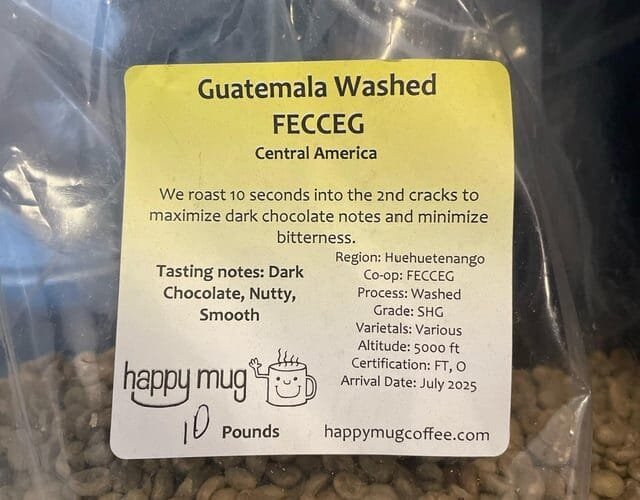
This might just change your routine: If you’re struggling to coax flavor from washed Guatamalan Huehuetenango on your R1 bullet, you’re not alone. The bean’s bright acidity and citrus-forward profile are notoriously tricky to highlight, especially when the roast feels flat. But the solution lies in precision—not just with heat, but with timing and technique. Washed Huehuetenango thrives on clarity. Its clean, vibrant notes of lemon zest, stone fruit, and a whisper of cocoa demand a roast that’s deliberate, not aggressive. The R1 bullet’s consistent heat is a plus, but without fine-tuning, it can flatten the bean’s natural brightness. Start…
Read More
First Roast with Gene Cafe CBR-101: A Roaster’s Honest Take

First Roast with Gene Cafe CBR-101: A Roaster’s Honest Take

First time behind the roaster, and the results? A mix of triumph and curiosity. You preheated to 235°C for five minutes, then let the beans take over—only to realize the green was gone by 6:15. A quick temperature hike to 245°C followed, but first crack? You’re not sure if it was 10 minutes or a trick of the light. You stopped at 12 minutes, cooled in a sieve, and now you’re questioning whether this was medium or flirting with medium-dark. The math doesn’t lie: 250g in, 209g out. A 16.4% loss—more than the average 12–15% for a medium roast. The…
Read More
Is Your Roast’s Line Too Light? Decoding the Mystery of Medium Roasts

Is Your Roast’s Line Too Light? Decoding the Mystery of Medium Roasts

There's something brewing in your kitchen—literally. You’ve taken the plunge into home roasting, chasing that perfect cup of coffee, but now you’re staring at a batch of beans that look like they’ve been through a storm. The line is lighter than expected, the outside darkens faster than a summer storm, and you’re left wondering: is this a sign of underdevelopment, or just the natural rhythm of the roast? Let’s cut through the confusion. When you roast coffee, the “line” refers to the point where the bean’s outer shell cracks open, signaling the start of the first crack. This is the…
Read More
The Secret to Fruit-Forward Roasts: Why Shorter Development Times Work

The Secret to Fruit-Forward Roasts: Why Shorter Development Times Work

Pour yourself a cup for this one: coffee roasting isn’t about chasing ratios—it’s about mastering development time. For years, I clung to 40/40/20 or 40/45/15 ratios on my SR800 fluid bed roaster, only to stare at underwhelming fruit notes. The numbers felt safe, but the results? Bland. Take a 10-minute roast reaching first crack at 8 minutes: 20% development time. The outcome? A flat, unremarkable cup. But when that same roast hit first crack with just 30 seconds of development time—5.88% DT—it burst with sweetness, brightness, and a vibrant fruit profile. That’s the magic I’ve leaned into 99% of the…
Read More
The Strange Silence of Robusta Roasting

The Strange Silence of Robusta Roasting

There's something brewing in the world of Robusta roasting that’s leaving even seasoned roasters scratching their heads. A Reddit user shared their experience with an Indian Robusta, roasted on an SR800 with a razzo tube, and described a process that defies expectation. The coffee followed the standard roasting arc—drying, yellowing, browning—but skipped the first crack entirely. Instead of the telltale snap signaling the start of development, it browned as if it had already cracked. The user, aiming for espresso, eventually hit the second crack, yielding a cup that tasted fine when blended with a Rwanda. But the question lingers: is…
Read More
The Hidden Flavor Divide in Coffee Grading

The Hidden Flavor Divide in Coffee Grading

Real talk: Coffee grading isn’t just about aesthetics. Screen size—a metric that separates beans into tiers—has become a proxy for quality, but its real-world impact on flavor remains murky. For growers and buyers, larger screens often mean higher prices, yet the connection between bean dimensions and cup performance feels increasingly abstract. Take Kenya, where size 20 beans (larger) and size 16 beans (smaller) are both meticulously sorted. If both are clean, defect-free, and roasted to match, what’s the actual difference? The answer lies in the interplay of density, moisture, and structural integrity. Larger beans, often heavier, absorb water more evenly…
Read More
The Libra vs. AGS Grinders: Decoding Flavor Differences

The Libra vs. AGS Grinders: Decoding Flavor Differences

Consider this your morning briefing: When it comes to espresso, the grinder you choose isn’t just about grind size—it’s about how the beans breathe. The Eureka Libra and All Ground Sense (AGS) are two legends in this space, but their philosophies diverge like coffee and tea in a café. The Libra, with its conical burrs, is a traditionalist’s tool, while the AGS, with its flat burrs, leans into precision. But how do these differences translate to flavor? The Libra’s reputation hinges on its ability to coax out depth and richness. Conical burrs create a more uneven grind, which means slower…
Read More
Elevate Your Brew: Top Espresso Machines for UK Coffee Lovers

Elevate Your Brew: Top Espresso Machines for UK Coffee Lovers

Consider this your morning briefing: If you’re craving a step up from your Sage Bambino Plus, you’re not alone. After two years of reliable service, the itch to upgrade is real—and the UK market has some serious contenders. Your needs? PID control, better build quality, temp stability, and a footprint that fits under a kitchen cupboard. With a budget of up to £1,500, you’re balancing practicality with the dream of a prosumer-grade machine. Let’s cut through the noise. The Profitec Go is a standout for its compact size, PID control, and solid build. At £850–900, it’s a no-brainer for space-conscious…
Read More
The Milk Texturing Conundrum: Why Your Latte Just Won’t Foam Right

The Milk Texturing Conundrum: Why Your Latte Just Won’t Foam Right

There’s something brewing in your milk pitcher that’s holding you back. You’ve mastered the espresso, but the milk? It’s thin, lifeless, and stubbornly uncooperative. You’re doing everything “right”—airing it out, heating it to 65°C, even hearing that telltale paper-kiss sound—but the result is still a flat, paint-like consistency that won’t hold a latte art stroke. The problem isn’t your machine or your technique; it’s the invisible dance between temperature, texture, and timing that you’re missing. The first crack in the milk’s texture usually starts with temperature. While 65°C is the sweet spot for most, it’s not just about reaching that…
Read More
Volodymyr Petrina: The 22-Year-Old Barista Shaping Prague’s Coffee Future

Volodymyr Petrina: The 22-Year-Old Barista Shaping Prague’s Coffee Future

Consider this your morning briefing: At 22, Volodymyr Petrina has already redefined what it means to be a barista in Prague. Born in Ukraine, this prodigy moved to the Czech Republic with a simple curiosity about coffee—and a hunger to master it. Within four years, he’s claimed national titles, represented his country on the global stage, and now trains baristas across six Mazelab cafés. For Petrina, coffee isn’t a craft; it’s a language of precision. Every cup is a conversation between bean and brewer, and he’s fluent in both. Petrina’s journey began with a burnt cup of over-roasted coffee in…
Read More