

⏱ 1 min read
The Short Version
If your espresso turns watery mid-shot and leaves behind a sodden puck, you aren't facing a grind issue—you’re witnessing channeling. Stop obsessing over dose weight and start mastering WDT distribution to eliminate the clumps that sabotage your extraction physics.
In This Article
Consider this your morning briefing: achieving a perfect extraction often feels like chasing a moving target. When your ratios look correct—an 18g dose yielding 36g in 25 seconds—but the liquid tastes thin and watery, something is fundamentally broken in the physics of your shot. A common symptom is seeing an early “blonde” phase where the stream loses body mid-extraction, leaving you with a lackluster cup and a sodden, waterlogged puck.
The espresso coming out gets way more watery, thin, and blonde around fifteen seconds into the shot.
Identifying Channeling Risks
The visual evidence of a wet puck combined with a sudden thinning of the espresso suggests that your water isn’t moving through the coffee uniformly. If you see parts of the filter grill exposed halfway through the shot, you aren’t dealing with a simple grind issue; you are witnessing channeling. This occurs when water finds the path of least resistance, carving out tunnels through the grounds rather than saturating them evenly. The espresso coming out gets way more watery, thin, and blonde around fifteen seconds into the shot. Once these channels form, the pressure drops, the flow accelerates through those gaps, and the structural integrity of the espresso disappears.
Beyond Grind Adjustments
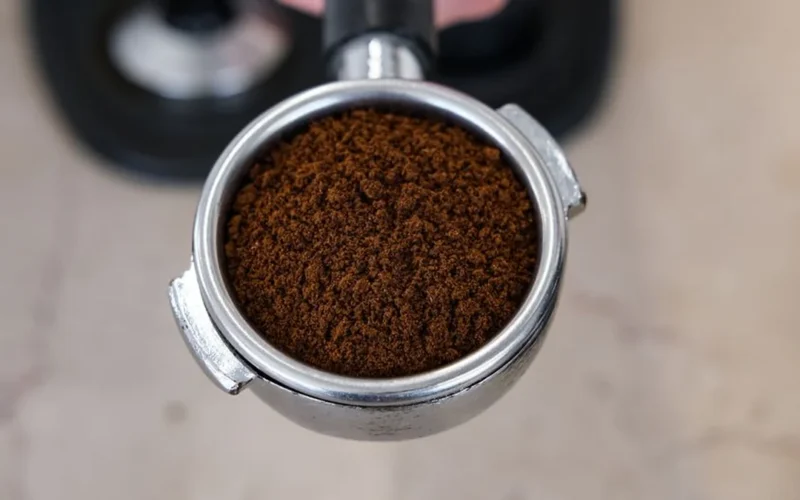
If varying your dose from 17g to 19g hasn’t corrected the texture, the problem likely lies in how you prepare the bed before the pump engages. Uneven distribution is the silent killer of high-pressure extraction. Even if your grind size is technically correct, any clumps or pockets of low density will trigger immediate channeling. Implementing a rigorous WDT (Weiss Distribution Technique) approach using fine needles can disrupt these clumps and ensure a level surface. Furthermore, since the Sage Barista Express lacks a sophisticated automated pre-infusion, manual intervention may be necessary to saturate the puck gently before full pressure hits. A consistent, even tamp and meticulous distribution are often more impactful than minor tweaks to the dose weight. By focusing on the uniformity of the coffee bed, you prevent the early thinning that leads to both poor flavor and a messy, wet puck. Do you find that manual distribution tools have made a noticeable difference in your shot consistency?
Questions & Answers
Why is my espresso thin and watery despite correct ratios?
Thin and watery espresso often results from channeling, where water finds the path of least resistance through the coffee grounds. Instead of saturating the bed evenly, the water carves tunnels that cause a sudden drop in pressure and an early blonde phase mid-extraction. This process destroys the structural integrity of the shot, leading to a lackluster cup that loses body quickly. This phenomenon is frequently accompanied by a sodden, waterlogged puck remaining in the portafilter after the shot finishes.
How can I prevent channeling when using a Sage Barista Express?
You can prevent channeling by focusing on meticulous coffee distribution and ensuring a consistent, even tamp. Using tools like the Weiss Distribution Technique (WDT) with fine needles helps disrupt clumps and pockets of low density that trigger uneven water flow. Since the Sage Barista Express lacks sophisticated automated pre-infusion, manual intervention to gently saturate the puck before full pressure is applied can also be effective. These steps ensure the water moves uniformly through the coffee bed rather than creating tunnels.
What are the visual signs of channeling during an espresso extraction?
Visual signs of channeling include seeing parts of the filter grill exposed halfway through the shot and noticing a sudden thinning of the liquid. You may observe an early blonde phase where the espresso stream loses its body and becomes watery around fifteen seconds into the process. Additionally, a common symptom of this issue is the presence of a messy, wet, or waterlogged puck after the extraction is complete. These indicators suggest that water is not moving through the grounds uniformly.
How does uneven coffee distribution affect espresso quality?
Uneven distribution acts as a silent killer of high-pressure extraction by creating pockets of low density within the coffee bed. When the pump engages, water avoids dense areas and rushes through these weak spots, carving out channels that lead to rapid, uncontrolled flow. This results in an espresso shot that becomes thin and blonde much earlier than expected. Proper distribution techniques are often more impactful for maintaining shot consistency and flavor than making minor adjustments to the total dose weight.
Originally reported by Reddit Coffee.



[…] verdict is in: espresso physics doesn’t always follow the intuition of your training. When experimenting with a Full City […]