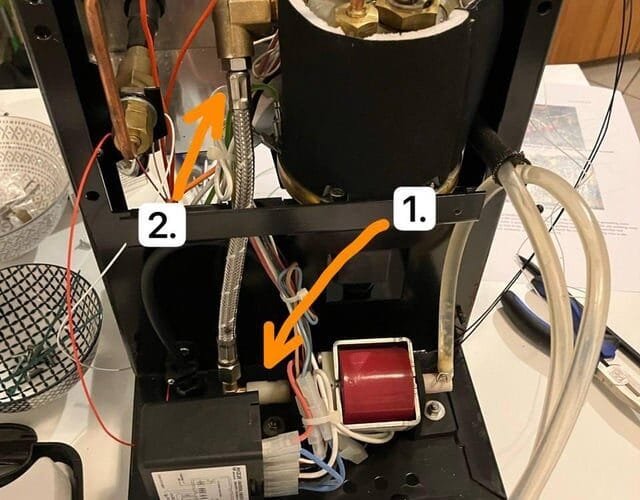
Real talk: If you’re modding your Rancilio Silvia, the placement of your pressure gauge isn’t just a tweak—it’s a decision that shapes how you understand your machine’s performance. The debate over T-connector positions has sparked endless threads, but the truth is simpler than the arguments suggest. Position 1 measures pump pressure, which is inherently less useful for brewing, while position 2 captures brew pressure—the actual metric that matters. Position 3, meanwhile, is a nightmare of engineering, requiring custom fittings that most homebrewers can skip. If you’re not chasing a pressure dimmer, simplicity wins.
The portafiler screw-mounted gauge is the unsung hero here. It’s straightforward, reliable, and avoids the headache of T-connector hacks. But if you’re set on a custom setup, position 2 is your best bet. It aligns with the pump’s output while reflecting the pressure the coffee actually experiences. Fluid dynamics don’t lie: the pump’s pressure is a starting point, but the brew pressure is the final act. The Auber PID you’ve got adds another layer—monitoring temperature is critical, but without a pressure dimmer, you’re limited to observation, not control.
This isn’t about choosing between options—it’s about clarity. A gauge in position 2 gives you actionable data without overcomplicating your system. The portafiler is a minimalist’s ally, and the PID’s role is to keep the roast in check, not to micromanage pressure. If you’re modding for insight, not control, you’re already halfway there.
So here’s the takeaway: Prioritize brew pressure over pump metrics, lean into simplicity, and let the PID handle the rest. But wait—what’s your experience with gauge placement? Did you go for a custom setup or stick with the portafiler? We want to hear your story.
Questions & Answers
Where should I place the pressure gauge on my mod?
Place the pressure gauge near the engine manifold for accurate readings. Ensure it’s accessible and not obstructed. Avoid high-heat areas to prevent damage.
Can I use any pressure gauge for modding?
No, use a gauge rated for your mod’s pressure range. Check compatibility with your system to avoid inaccurate readings or damage.
Information sourced from industry reports and news outlets.