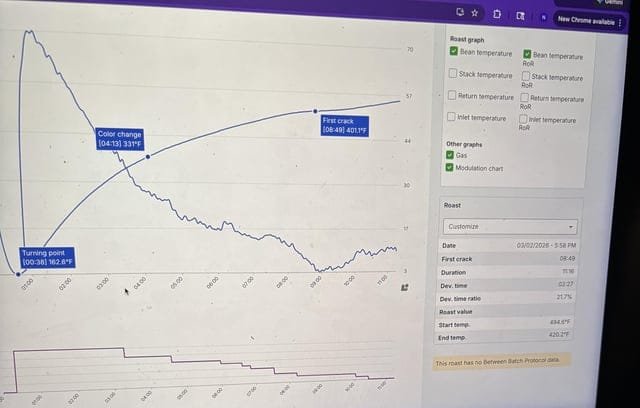
Switching roasters changed everything—here’s why your espresso might be tasting bitter. If you’ve moved from an Aillio Bullet to a Loring S15, you’re probably noticing a shift in flavor. Production roasts now take 10.5–11 minutes instead of 8–9, and that extra time is leaving your espresso with a dry, bitter finish, especially in lattes. The problem isn’t just about time—it’s about how the Loring handles heat and airflow, which alters the roast’s trajectory. Your curve shows a crash followed by a flick right after first crack, a pattern some say is common with Loring machines. But if you’re tasting bitterness, that crash might be doing more than just signaling a phase change.
The longer roast time is likely the culprit. At 25 lbs, the Loring’s slower ramp-up means beans spend more time in the critical window between first and second crack. This can over-extract certain compounds, especially in milk-based drinks where the bitterness is amplified. The darker interior of your beans—Agtron readings at 61.4 whole bean, 68.9 ground—suggests a higher roast level than your Bullet samples. While some argue this is standard for production, the difference in cup profile is clear. The key is balancing darkness with acidity to avoid that dry, astringent finish.
You’re not alone in this dilemma. Many roasters report similar issues when scaling up. The Loring’s design prioritizes even heat distribution, but that can also mean slower development. To mitigate bitterness, consider shortening the roast time slightly or adjusting the cooling phase to reduce over-extraction. Also, monitor your curve’s crash—too aggressive, and you risk burning the beans. The goal isn’t to eliminate the crash but to control its timing.
If you’re aiming to cut waste, focus on precision. A 25-lb batch is a lot, so small tweaks in temperature or airflow can make a big difference. But if the bitterness persists, it’s worth questioning whether the Loring’s profile is right for your coffee.
Have you found a way to balance darkness and flavor.
What’s your experience with Loring roasts? Have you found a way to balance darkness and flavor?
Questions & Answers
What does Loring espresso roast taste like?
Loring espresso roast has a bitter, dry finish with dark chocolate and toasted nuts. It’s intense and full-bodied, ideal for espresso.
Is Loring espresso roast suitable for espresso?
Yes, Loring espresso roast is specifically crafted for espresso. It delivers a bold, bitter finish with rich flavors that complement espresso extraction.
Information sourced from industry reports and news outlets.