⏱ 2 min read
The Short Version
Forget predictable Tuscan heavyweights; the Merano Winefestival revealed an Italy defined by stylistic rebellion. From high-altitude Rieslings in Piedmont to aromatic, amphora-aged whites from Abruzzo, producers are ditching convention to prove that Italian terroir is anything but one-dimensional.
The Merano Winefestival proved that Italy’s wine scene is far from predictable. While local specialties anchored the event, the real draw was seeing producers push boundaries through unexpected varietals and unconventional aging methods. From high-altitude Rieslings in Piedmont to amphora-aged whites from Abruzzo, the festival highlighted an Italian landscape defined by stylistic deviation.
Massolino is, of course, much better known for its Barolo, so this was an interesting discovery.
Regional Deviations and Rare Varieties
While many look to Tuscany for heavy hitters, Banfi’s Poggio alle Mura Brunello di Montalcino Riserva 2020 stood out for its seamless integration of barrique aging. The wine delivered concentrated red berries and balsamic notes with juicy tannins that felt polished rather than overpowered by oak. In a different direction, Massolino—a name synonymous with Barolo—offered a compelling detour with their 2024 Langhe Riesling. Grown between 530–600 meters in Monforte d’Alba, this 100% Riesling expressed citrus and green apple with a long, slightly saline finish. Massolino is, of course, much better known for its Barolo, so this was an interesting discovery.
Indigenous whites also showed significant depth, particularly the Iana Verdicchio di Matelica Vecchie Vigne DOC 2024. Sourced from roughly 60-year-old vines, it offered a rounded palate of ripe citrus and white flowers balanced by a bitter almond finish. Similarly, Blasi Cantina from Umbria showcased the versatility of traditional grapes with their 2025 Grechetto, which leaned into fresh, white-fleshed fruit and lively acidity. Even their Tiberinus Rosso Colli Altotiberini 2024 proved successful, blending 60% Sangiovese, 20% Merlot, and 20% Sagrantino to balance local character with international influence.
Amphora Aging and Sparkling Nuance
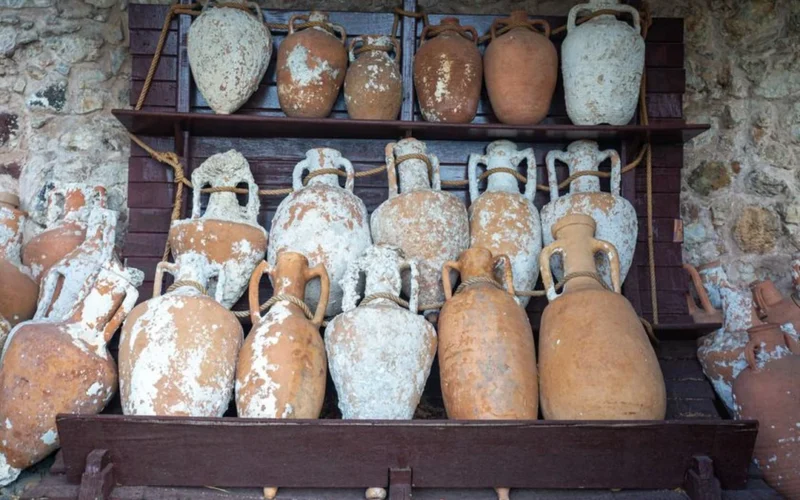
The most striking technical displays came from Vinum Hadrianum in Abruzzo, a producer focused on amphora-aged wines. Their Maecia Amber Macerato Malvasia 2025 was highly aromatic, pairing ripe white fruit with a pronounced phenolic character that remained surprisingly harmonious. They also utilized the rare Maiolica grape for their Matrinus Maiolica, producing a wine with significant volume and a distinctive spicy profile.
Even the sparkling category challenged preconceived notions. While Prosecco is often viewed as an affordable alternative to Franciacorta, Stefano Bottega’s 2024 Rosé Millesimato Extra Dry offers something more rebellious. Because Raboso makes up the largest part of the blend alongside Glera and Chardonnay, it strictly cannot be called Prosecco—a distinction that makes it all the more intriguing. It delivers a soft, fruity palate of red berries that defies standard expectations.
Do you find that amphora aging adds too much texture to indigenous varieties, or does it enhance their natural character?
Questions & Answers
What makes Stefano Bottega’s 2024 Rosé Millesimato different from standard Prosecco?
Stefano Bottega’s 2024 Rosé Millesimato Extra Dry differs from Prosecco because its blend is primarily composed of Raboso alongside Glera and Chardonnay. Because Raboso makes up the largest part of the blend, the wine strictly cannot be classified as Prosecco. This unique composition allows the wine to defy standard expectations by delivering a soft, fruity palate characterized by red berries, offering a more rebellious alternative to traditional sparkling options.
How does the Massolino 2024 Langhe Riesling differ from the producer's typical wine offerings?
The Massolino 2024 Langhe Riesling represents a stylistic detour for a producer that is much better known for its traditional Barolo. This specific wine is grown at high altitudes between 530 and 600 meters in Monforte d'Alba. Unlike their heavy reds, this 100% Riesling expresses bright citrus and green apple notes with a long, slightly saline finish, showcasing the producer's ability to master unexpected varietals outside of their usual Piedmontese specialties.
What characteristics are found in the amphora-aged wines from Vinum Hadrianum?
Vinum Hadrianum produces highly aromatic wines with pronounced phenolic character through the use of amphora aging. Their Maecia Amber Macerato Malvasia 2025 pairs ripe white fruit with a harmonious texture that highlights the technical benefits of the vessel. Additionally, the producer utilizes the rare Maiolica grape to create the Matrinus Maiolica, which results in a wine defined by significant volume and a distinctive spicy profile that sets it apart from standard aged whites.
Which grape varieties are used to create the Tiberinus Rosso Colli Altotiberini 2024?
The Tiberinus Rosso Colli Altotiberini 2024 is created using a blend of Sangiovese, Merlot, and Sagrantino. Specifically, the composition consists of 60% Sangiovese, 20% Merlot, and 20% Sagrantino. This particular combination is designed to balance local Italian character with international influence, allowing the wine to represent the diverse stylistic possibilities found within the Umbrian wine landscape.
Originally reported by Reddit Wine.