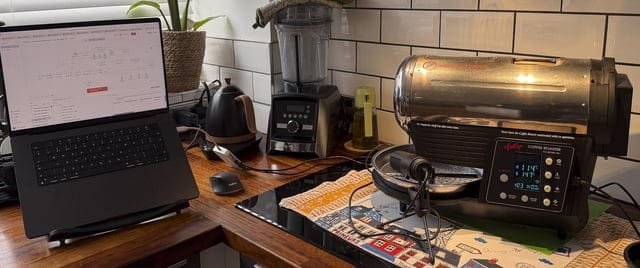
Real talk: coffee roasting has always been an art—and now, it’s becoming a science. For months, I’ve been testing a prototype first-crack detector paired with an LLM loop on my Hottop KN-8828B-2K+ to dial in roast consistency. The setup? A single USB mic pointed at the drum, a small model that flags 10-second windows with first-crack activity. It’s not a replacement for the ear, but it’s reshaping how I approach post-crack adjustments.
The surprise? Consistency. I’ve been charging beans at 170–18, which is way hotter than the Hottop’s recommended 110°C range. Probe readings have likely drifted over time, so I treat them as relative. The hotter charge, combined with sharp heat cuts at first crack, delivers light to medium roasts—a result I’d never predicted from textbook theory. My manual Artisan attempts usually ended up darker than intended. This setup, however, meets my bar: repeatable enough to hand out a bag without apologizing.
The loop itself is a hybrid of automation and human oversight. An n8n workflow ties two MCP services: one for FC detection, one for roaster control. I preheat the drum to ~170°C, then let an LLM agent (via OpenAI and LangChain) read temps, adjust fan and heat, and infer charge from temperature drops. Safety limits—bean temp ceilings, RoR bounds—live in the workflow, not the model. About 80% of roasts land where I want them. It’s not autonomous control; it’s a system prompt guiding a fixed set of tools. I stay in the room for safety, not to micromanage.
What’s next? A refined first-crack detector with a new dataset, multi-mic sync, and real-time tasting feedback. The goal? Tie roast audio and notes back to profiles, creating a self-improving loop. All runs on a Raspberry Pi 5, keeping variables minimal: charge temp, fan, heat, FC timing, and tasting notes. Bean origin, altitude, and ambient factors? Maybe someday.
It’s free, no sign-up, and returns firstcrack/nofirst_crack probabilities.
If you’re experimenting with Hottop profiles, I’d love to compare labeled Artisan data. My manual curves are mostly unlabelled, and I want to see what “good” looks like before baking assumptions into the next build. Try the FC detector demo? It’s free, no sign-up, and returns firstcrack/nofirst_crack probabilities. Failures are fascinating—so are your stories. What’s your take on blending tech and tradition in the roastery?
Close: How do you balance intuition and data when chasing roast consistency?
Questions & Answers
How does a first-crack detector improve roast consistency?
It flags first-crack activity in 10-second windows, helping adjust post-crack timing for more consistent roasts.
What temperature range is recommended for Hottop roasting?
The Hottop recommends 110°C, but some users charge hotter for light to medium roasts with precise heat cuts.
Information sourced from industry reports and news outlets.