⏱ 1 min read
The Short Version
Lao Banzhang’s rare, high-altitude pu-erh flavor is shaped by its unique terroir, yet it’s often confused with mass-produced imitations due to its complex, earthy, and floral profile.
In This Article
Lao Banzhang isn’t just a tea—it’s a marker of origin. This rare, high-altitude pu-erh from Yunnan’s Menghai region possesses a complexity that is difficult to replicate, yet its true identity is frequently obscured by mass-produced imitations. The challenge lies not in choosing what to buy, but in understanding how to identify the genuine article.
Lao Banzhang’s character is rooted in its terroir—mountain altitude, soil composition, and microclimate—each contributing to its mineral-rich, floral profile.
The Terroir of Lao Banzhang
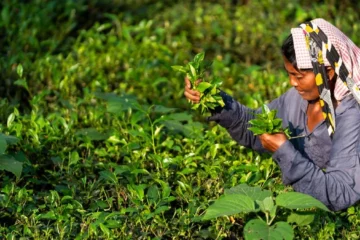
Lao Banzhang’s character is rooted in its terroir—mountain altitude, soil composition, and microclimate—each contributing to its mineral-rich, floral profile. Unlike lower-altitude pu-erh, which often leans toward sweetness, Lao Banzhang’s leaves absorb the mist-laden air of its cloud-forest environment, developing a distinct earthy foundation. The soil, rich in volcanic minerals, adds a subtle iron-like nuance, while the slow growth of high-altitude bushes intensifies its flavor. These elements make it a standard for pu-erh authenticity, yet they are frequently disregarded in favor of cheaper, bulk-produced alternatives.
Decoding Its Flavor Profile
The “archetypical” Lao Banzhang is defined by a paradox: it’s both bold and delicate. Its dry leaves are dark, wrinkled, and heavy—indications of age and oxidation. When brewed, it reveals a balance of smoky depth and floral brightness, a contrast rare in most pu-erh. The aftertaste lingers with a faint woody bitterness, a signature of its origin. This complexity is not coincidental—it’s the outcome of centuries-old farming practices that value quality over quantity.
Lao Banzhang’s character is rooted in its terroir—mountain altitude, soil composition, and microclimate—each contributing to its mineral-rich, floral profile.
In recent years, modern technology has become an essential tool in verifying Lao Banzhang’s authenticity. DNA testing and geographic information systems (GIS) are now being used to trace the tea’s origin, offering a scientific approach to a traditionally subjective craft. These methods help distinguish genuine Lao Banzhang from imitations by analyzing genetic markers and environmental data.
Can you spot the difference between a genuine Lao Banzhang and a well-crafted imitation?
Questions & Answers
How does terroir influence the flavor of Lao Banzhang?
Terroir shapes Lao Banzhang’s flavor through altitude, soil, and microclimate. High-altitude growth and volcanic soil contribute to its mineral-rich, floral profile. The cloud-forest environment adds an earthy foundation, while the slow growth intensifies its complexity, making it a benchmark for pu-erh authenticity.
What makes Lao Banzhang’s flavor profile unique?
Lao Banzhang’s flavor is both bold and delicate, with smoky depth and floral brightness. Its dry leaves are dark and wrinkled, indicating age and oxidation. Brewed, it reveals a balance of earthy bitterness and a lingering woody aftertaste, a signature of its high-altitude origin and traditional farming methods.
Why is Lao Banzhang often confused with imitations?
Lao Banzhang is frequently confused with imitations because its true identity is obscured by mass-produced alternatives. These cheaper versions lack the terroir-driven complexity of authentic Lao Banzhang, which is shaped by high-altitude, volcanic soil, and a unique microclimate, making it difficult to replicate.
How are modern methods helping verify Lao Banzhang’s authenticity?
Modern technology like DNA testing and GIS is helping trace Lao Banzhang’s origin. These tools provide a scientific approach to verify its authenticity, ensuring that the tea’s unique terroir characteristics are not lost in mass production, and offering a reliable way to distinguish genuine Lao Banzhang from imitations.
Originally reported by Reddit Puer Tea.