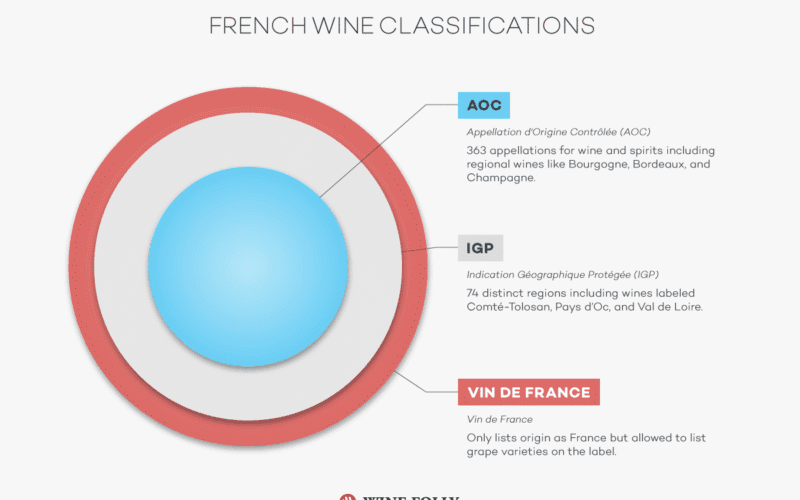
France’s wine labels are a language of precision, but decoding them feels like solving a mystery. Enter AOC—the Appellation d’Origine Contrôlée—France’s strict system for defining wine identity. It’s not just a label; it’s a guarantee of origin, rules, and quality. Think of it as the wine world’s version of a fingerprint: if it’s labeled AOC, you know exactly where it came from and how it was made.
AOC isn’t just about geography. It’s a legal framework enforced by the Institut National de l’Origine et de la Qualité (INAO), which sets rules for grape varieties, yields, and even vine density. For example, a bottle labeled “Champagne” must be sparkling, made from Chardonnay, Pinot Noir, or Meunier, and aged in the Champagne region. These rules protect reputation, ensuring that if you pay for a bottle of AOC Bordeaux, you’re getting a product shaped by centuries of tradition.
But AOC isn’t the only game in town. IGP (Indication Géographique Protégée) offers more flexibility. Producers can experiment with grape blends or methods, leading to greater diversity. Yet, this freedom comes with trade-offs: fewer rules mean wider quality gaps. In 2025, INAO even approved low-alcohol IGP wines (as low as 6% ABV) for regions like Val de Loire, signaling a shift toward innovation. Still, IGP lacks the strictness of AOC, making it a riskier bet for collectors.
At the bottom of the hierarchy sits Vin de France, essentially table wine without a protected origin. It’s the least regulated, which means no guarantees about terroir or style. Some winemakers even choose to declassify their wines to Vin de France, like Liber Pater’s 2015 Graves vintage, which used ancient grapes banned in Bordeaux. These outliers prove that classification systems are guidelines, not absolutes.
IGP offers flexibility but less consistency, ideal for experimentation.
KEY POINTS: AOC ensures strict origin and production rules, making it the gold standard for authenticity. IGP offers flexibility but less consistency, ideal for experimentation. Vin de France is the least regulated, often lacking the precision of higher-tier classifications.
So next time you see an AOC label, ask yourself: What does that mean for your glass?
Questions & Answers
What are the main French wine classifications?
Main classifications include Appellation d’Origine Contrôlée (AOC), IGP, and Vin de France. AOC is the strictest, ensuring quality and origin.
How does AOC affect wine pricing?
AOC wines often cost more due to strict production rules, limited yields, and reputation. This reflects quality and authenticity.
Information sourced from industry reports and news outlets.