Maillard

Mastering Chocolate Notes: A Cubean Roaster’s First Manual Roast Breakdown

Mastering Chocolate Notes: A Cubean Roaster’s First Manual Roast Breakdown

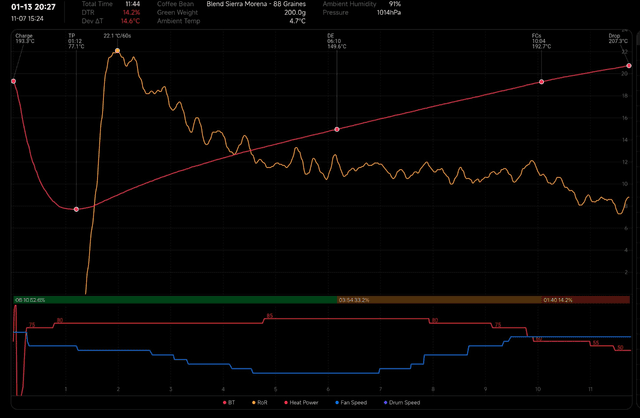
Real talk: Your first manual roast with a Cubean roaster isn’t just about timing—it’s about precision, patience, and a dash of science. You’ve already seen how automatic profiles can feel like a passive exercise, leaving your beans flat and underdeveloped. Now, you’re chasing that sweet, chocolatey complexity—and the question is: how do you nail it? The answer lies in understanding the rhythm of the roast, not just the heat. The key is the ROR (Rate of Rise) curve. You noticed it’s tricky to get that curve to trend down, and that’s not a mistake—it’s a clue. A steep ROR early…
Read More
How to Master Light Roast Development Without Sacrificing Flavor

How to Master Light Roast Development Without Sacrificing Flavor

This is worth savoring: Light roasts demand precision, and the devil is in the details of timing. If you’re chasing a filter roast with a short dry phase and Maillard, you’re already in a tightrope act—balancing speed and depth. The numbers you’re working with—4:15 dry, 3:15 Maillard, 1:25 development—hint at a race against time. But here’s the catch: your ROR (rate of rise) spikes during development, threatening to cut the window for complexity. The question isn’t just about how to slow the roast—it’s about how to let the beans breathe without losing their brightness. The core issue lies in the…
Read More
The Roast That Smelled Like Heaven

The Roast That Smelled Like Heaven

This is worth savoring: A rookie roaster’s obsession with unlocking sweet chocolate notes in a Costa Rican blend led to a revelation that’s equal parts science and serendipity. After three days of trial, error, and a dash of madness, the beans finally exhaled the aroma of hot cocoa—so potent even a coffee-hating spouse declared it divine. The journey? A masterclass in how temperature, timing, and patience can transform a batch of coffee into a sensory masterpiece. The first roast, a dark, slow burn at 23 on the Cubean, yielded underwhelming espresso. The beans, charged at 180°C and roasted to 209°C…
Read More
Unlocking the Fruity Soul of Natural Process Coffee

Unlocking the Fruity Soul of Natural Process Coffee

If you’ve ever wondered why some light roasts sing with fruitiness while others fall flat, you’re not alone. Natural process coffees, especially from Colombia, are known for their vibrant acidity and tropical notes, but mastering their aroma is an art. The user’s struggle—capturing that elusive bright, berry-forward profile—highlights a common challenge: balancing light roasting’s delicacy with the risk of underdeveloped flavors. The key lies in understanding how temperature, timing, and bean origin shape aroma. Light roasts preserve the coffee’s inherent characteristics, but they demand precision. A natural process coffee’s fruitiness stems from its high acidity and fermentation during drying, which…
Read More