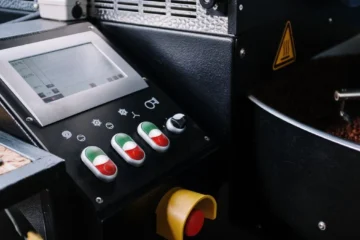
There’s something brewing in the world of coffee roasting—literally. For those transitioning from sample roasts to full batches, the Aillio roaster isn’t just a tool; it’s a gateway to scaling with precision. But scaling up isn’t just about bigger batches; it’s about rethinking every step of the process. Take Roger Morse, who swapped a 200-250g roaster for the Aillio’s 600-700g capacity. Suddenly, his green bean orders needed a rethink. Where he once bought 1kg of coffee for four roasts, he’s now splitting 2kg into three 666g batches. The question isn’t just about quantity—it’s about how to translate a 150g sample roast into a full-scale profile.
The challenge lies in the physics of heat distribution. A sample roast’s power curve and charging temp are tailored for small batches, but scaling up demands a different approach. Manual adjustments? Maybe. But relying on guesswork risks inconsistency. Enter the overlay function—a lifeline for matching sample profiles to larger batches. Yet even with tools, the art remains: balancing precision with intuition. Morse’s experiment with Rob Hoss and Steffen Lav’s samples shows that success hinges on adapting, not replicating.
Here’s the rub: scaling isn’t a one-size-fits-all move. Batch size changes the dynamics of heat retention, airflow, and timing. A 600g roast requires a slower, more controlled ramp-up to avoid scorching. Power curves must shift to maintain even roasting. And while sample roasts offer a starting point, they’re just a baseline. The real magic happens in tweaking for scale—adjusting temps, refining curves, and trusting your palate to catch nuances a machine might miss.
Key points: Adjust your power curves and charging temps to match the scale of your batches. Use sample roasts as a foundation but don’t hesitate to tweak for larger quantities. Invest in tools like overlay functions to maintain consistency across different batch sizes.
What strategies have worked—or failed—for you.
Have you ever tackled the challenge of scaling your roasts? What strategies have worked—or failed—for you?
Questions & Answers
How long does it take to make a full batch from a sample profile?
Time varies by recipe and equipment, but typically 1-2 hours. Monitor temperature and timing closely for best results.
Can I use any coffee bean for batch brewing?
No, not all beans work well. Use freshly roasted, medium to dark roast beans for best flavor and consistency.
Information sourced from industry reports and news outlets.